 |
| The date has finally been set! The new Lincoln Heritage Museum will have a Soft Opening at the annual Grand Soiree September 28th, 2013 and have its Grand Opening October 26th, 2013! We hope to see you all at these two events! |
Friday, May 31, 2013
The Date Has Been Set!


Monday, October 22, 2012
October 24th, 2012 Presentation and Book Signing for Guy Fraker’s “Lincoln and the Eighth Judicial Circuit”
The Lincoln Heritage Museum invites you...
to join us for a special presentation and book signing by
historian- author- local attorney
Guy Fraker


with his newly released book Lincoln's Ladder to the Presidency: The Eighth Judicial Circuit
Wednesday, October 24, 2012 at 7pm
Lincoln Heritage Museum, Lincoln, Illinois
Presitation free to the public- Book Sale/ Signing to follow
For 23 years Abraham Lincoln rode Central Illinois' Eighth Judicial Circuit, building his law practice and his political base. The circuit, with its leaders and lawyers, was truly Lincoln's "ladder to the presidency."
"If you want to understand why and how President Lincoln became the lawyer in the White House, read this book. No one has described the tedium of the Lincoln law practice as well as this author- his friends, enemies and associates, as well as the people they represented, are all here." - Frank Williams, Retired Chief Justice of the Rhode Island Supreme Court

Books are $34.95. For more information
(217) 732-3155 ext. 295 or rkeller@lincolncollege.edu
Lincoln Heritage Museum. 300 Keokuk Street Lincoln, IL 62656
Thursday, September 6, 2012
Lincoln Heritage Museum's Grand Soiree

The Lincoln Heritage Museum invites you to join us in night of support of the Lincoln Heritage Museum, Saturday, September 29th, at the Lincoln Center on the Lincoln College Campus. This highly anticipated event will have a elegant dinner, auction, a first look at the new museum design, and entertainment provided by Lincoln College’s jazz band and choir.
The Grand Soiree will begin at 6 p.m. and all funds received will go to the Lincoln Heritage Museum. To reserve your seat, or for information on how you can be an underwriter or table host, please contact Ron Keller at (217) 732-3155 x295 or at rkeller@lincolncollege.edu
Friday, May 11, 2012
Tea Time With Helen Edwards

Edwards Place is offering kids ages 6-12 a chance to step back in time and learn what life was like when the Edwardses and Lincolns lived in Springfield. This special workshop will take place on June 9 from 1 to 3 pm.
Anne Suttles of the Lincoln Heritage Museum will portray Helen Edwards as she teaches children about how to set a table, ladies’ clothing in the 19th century, what ladies read, proper social etiquette, and the “language of the fan.” Children will also make a rag doll and decorate a fan of their own to take home.
The cost of the workshop is $15 per child. Advance reservations are required and can be made by calling 217-523-2631 or emailing collections@springfieldart.org. The deadline to register is June 7.
 |
| The Edwards Place is located at 700 North 4th Street Springfield, Illinois 62702 |
Wednesday, April 4, 2012
Happy Birthday Tad Lincoln!

On April 4, 1853 Thomas Lincoln was born. Originally named after Abraham’s father Thomas Lincoln, but Thomas is not how he is remembered. When Thomas was born his father described him as “wiggly as a tadpole” and started calling him Tad. Over the years scholars would recognize Thomas as Abraham’s father, and Tad as his son. This small but fond nickname placed Tad in the history books in regards to Lincoln but his character as an individual created who he was. Not much is record about Tad’s early life in Springfield. It is known that Tad did not like academics like his brother Willie and did not have a drive like his oldest brother Robert. This was probably in part of Tad’s learning disability and speech impediment. According to Margarita Spalding Gerry, editor, Through Five Administrations: Reminiscences of Colonel William H. Crook she quotes the White House guard William Crook as he later recalled:
"Taddie could never speak very plainly. He had his own language; the names that he gave some of us we like to remember to-day. The President was 'papa-day,' which meant 'papa dear.' Tom Pendel was 'Tom Pen,' and I was ‘Took.' But for all his baby tongue he had a man's heart, and in some things a man's mind. I believe he was the best companion Mr. Lincoln ever had — one who always understood him, and whom he always understood."[1]
Even though Tad had his distractions and difficulties he did have a knack of using his wild imagination to make life interesting for the Lincoln family and would in his own way help his father. This is seen mostly by his mother and the White House staff. Most of the instances with Tad took place in the White House and Tad was usually pared with his quiet and poetic brother Willie. According to Inside the White House in War Times editor, Dr. Michael Burlingame, quotes William O. Stoddard as he describes Willie and Tad in the White House:
“What a yell! But it comes from the forces belonging to quite another seat of war. Tad has been trying to make another seat of war. Tad has been trying to make a war-map of Willie, and there are rapid movements in consequence on both sides. Peace is obtained by sending them to their mother, at the other end of the building, but the President does not return to his desk. He is studying one of the maps he has pulled down from the spring-roller above the lounge on the eastern side of the room. It is an outline map of West Virginia and the mountain ranges, and it is likely that something important is going on there.”[2]
With Willie and Tad pared together there was always a commotion going on. But this was the parenting Mary and Abraham continued from the day Robert was born they viewed that children were brought up with the philosophy of letting their children be children, and that is exactly what Willie and Tad did they were children.
 |
Tad carved his name into to top of the
rocking chair, LHM
|
 |
Tad Lincoln rocker,
Lincoln Heritage Museum (LHM)
|
When the Lincoln’s moved to the White House in 1861 the boys Robert, Willie, and Tad continued their studies. Robert left for Harvard and Willie and Tad had tutors in the White House. Willie and Tad had their own plans. They were famous for creating their own regiment out of the White house staff. They even had a doll Jack who according to Tad and Willie caused the most trouble. In the introduction to Julia Taft Bayne’s book Mary A. Decredico describes some of the instances Julia had with Willie and Tad: “The Taft and Lincoln boys staged a circus and charged five cents admission; they built forts and played soldiers; they were often found frolicking with Tad’s goats, Nako and Nannie, or with the dogs or pony that well-wishers gave them. Their mischief often involved the president. As Julia recalls, she “entered the study to find the four boys pinning down the president and begging her to help keep him down.
On another occasion, Julia Taft recounts that Tad’s doll, dressed in the gaudy uniform of a Zouave, was repeatedly executed for being asleep on watch. After the firing squad, he was accorded a military burial, much to the annoyance of the White House gardener, who found his flower beds dug up.”[3] These were just a few of the instances she describes in her book Tad Lincoln’s Father that give a bit of light to the effects Tad and Willie had on their father and those that surrounded them. But during the early years the Lincoln’s were in Washington tragedy would strike the Lincoln family. According to many scholars both Willie and Tad contracted typhoid fever but only one of the boys would recover. Doris Goodwin states in her book Team of Rivals,
“Slipping in and out of consciousness, Willie would call for his friend Bud Taft, who sat by his bedside day and night. Late one evening, seeing Bud at his son’s side, Lincoln ‘laid his arm across Bud’s shoulder and stroked Willie’s hair.’ Turning to Bud, he said quietly, ‘You ought to go to bed, Bud,’ but Bud refused to leave, saying, ‘If I go he will call for me.’”[4]
Willie was a much loved boy by both his parents and his friends. The Taft children were very close to Willie, but like his father Tad would have a tough time getting over his brother’s death like his father. But the Lincoln family continued on Robert still at school and Tad alone without Willie was still at the White House. Lincoln became busier and busier as the war went on and had little time with his two remaining sons and the war was becoming overwhelming. Tad trying to be closer to his father would interrupt meetings Lincoln had with cabinet members, and in some ways reminded Lincoln of his morals that he stood by. According to a story told by Ward Hill Lamon,
"The introductions were gone through with, and they turned out to be gentlemen Mr. Lincoln had been avoiding for a week. Mr. Lincoln reached for the boy, took him on his lap, kissed him, and told him it was all right, and that he had introduced his friend like a little gentleman as he was." Tad later explained that he called the men his "friends" because "they looked so good and sorry, and said they were from Kentucky, that I thought they must be our friends." His father replied: "That is right, my son. I would have the whole human race your friends and mine, if it were possible."[5]
Tad in his own way helped to keep Lincoln take a break from the weariness of the war and remind him of pleasanter times. In many ways this is what Abraham and Mary’s son provided for them, Tad was a constant reminder of happiness and hope. The Lincoln boys were the glue that held Lincoln together through the good and the bad times and shaped his way of thinking. In addition the boys helped to keep Lincoln on his path through his life and gave him new insights into the light and the dark in the world.
[1] Margarita Spalding Gerry, editor, Through Five Administrations: Reminiscences of Colonel William H. Crook, p. 23
[2] Michael Burlingame, editor, Inside the White House in War Times, p. 12
[3] Mary A. DeCredico. Julia Taft Bayne, Tad Lincoln’s Father. Lincoln, Nebraska: University of Nebraska Press.2001
[4] Doris Kearns Goodwin, Team of Rivals: The Political Genius of Abraham Lincoln. New York: Simon & Schuster. 2005: 419
[5] Ward Hill Lamon, Recollections of Abraham Lincoln, pp. 167-168
Wednesday, March 28, 2012
Special Presentation and Book Signing with historian-author Jason Emerson
The Lincoln Heritage Museum invites You
to join us for a special presentation and book signing by
historian-author
Jason Emerson


and his newly released book
Giant in the Shadows: The Life of Robert T. Lincoln
April 15, 2012 at 7 pm
Lincoln Heritage Museum, Lincoln, Illinois
Presentation free to the public - Book signing to follow
50 years after the last biography of Robert Lincoln, historian and author Jason Emerson illuminates the life of this remarkable man, uncovering new insights into Robert’s relationship with Abraham and Mary Lincoln.
More than a biography; it is a tale of American achievement in the Gilded Age
This presentation will be Emerson’s first appearance in Illinois since his newly released biography on Robert Lincoln, Abraham Lincoln’s oldest son. Entitled Giant in the Shadows: The Life of Robert T. Lincoln, the new publication has been long-anticipated by the Abraham Lincoln scholarship community.
Although he was Abraham and Mary Lincoln's oldest and last surviving son, the details of Robert T. Lincoln's life are misunderstood by some and unknown to many others. With the last biography of Robert Lincoln published nearly a half-century ago, Emerson draws upon previously unavailable materials to offer the first truly definitive biography of the famous lawyer, businessman, and statesman who, much more than merely the son of America's most famous president, made his own indelible mark on one of the most progressive and dynamic eras in United States history.
As a president's son, a Union soldier, minister to Great Britain, and a U.S. secretary of war, Robert Lincoln was indisputably a titan of his age. Much like his father, he became one of the nation's most respected and influential men, building a successful law practice in the city of Chicago, serving shrewdly as president of the Pullman Car Company, and at one time even being considered as a candidate for the U.S. presidency.
Emerson has already garnered much praise for his book. Respected historian Wayne C. Temple said of Giant In the Shadows that it is “beautifully written,” and calls the book, “one of the best Lincoln books to appear in many years.”
“Having had several conversations with Jason about this book,” says Lincoln Heritage Museum director Ron Keller, “I can safely say that some of the conclusions that Emerson makes in Giant in the Shadows will dramatically alter people’s perceptions about the complex relationships that Robert had with his parents Abraham and Mary Lincoln.”
As an added interest to the Logan County region, Emerson notes in his book several references Robert Lincoln made to the city of Lincoln, Illinois.
Jason Emerson is a journalist and an independent historian who has been researching and writing about the Lincoln family for nearly 20 years. His previous books include The Madness of Mary Lincoln, Lincoln the Inventor, and The Dark Days of Abraham Lincoln’s Widow, as Revealed by Her Own Letters. He lives near Syracuse, New York.
The presentation is free, and books will be available for sale afterwards for $39.95 plus tax.
For more information, contact Ron Keller at the Lincoln Heritage Museum at 217-732-3155 or rkeller@lincolncollege.edu.
Tuesday, January 31, 2012
2012: The most important election since 1860?
 |
| 1860 Presidential Campaign Banner for Abraham Lincoln and his running mate, Hannibal Hamlin (LHM) |
“It is the most important election since 1860,” said former House Speaker and Republican presidential candidate Newt Gingrich in a campaign speech this month in his home state of Georgia. Such a comparison to the epochal election of Abraham Lincoln in 1860 might be taken seriously, except that, well, we’ve heard similar talk before… a lot.
Such presentist notions are thrown around without abandonment in every presidential election. Why should 2012 be any different? Unfortunately, Gingrich did not design his statements to be historically retrospective of 1860 as much as he intended this as campaign rhetoric to energize the masses against the President Obama. Gingrich undoubtedly used this comparison to emphasize the urgency of the current issues we face, and I can only include that Gingrich truly does believe the election is of that magnitude. However, as bad as the current economic downturn is, to say that it rivals what Abraham Lincoln faced when he took office finding the nation torn in half is preposterous. After all, Lincoln himself found no comparison to what he faced in the Civil War, saying that “the dogmas of the quiet past are inadequate to the stormy present.”
As long as such a comparison of 2012 is made to 1860, I must wonder if Mr. Gingrich envisions himself as the modern-day Abraham Lincoln who will save the union from the direction the country is taking. But Gingrich is not alone in evoking Lincoln. President Obama also cloaked himself in Lincolnesque language this week as well. In his annual State of the Union address, the president told the nation, “I’m a Democrat. But I believe what Republican Abraham Lincoln believed: That government should do for people only what they cannot do better by themselves, and no more.” Consider that statement from a president whom many Republicans decry as a “socialist,” you will understand why they view his words quite incredulously.
In the days of multi-million dollar campaigns and constant media barrage of political speechmaking by the candidates, it is difficult to compare modern politicking and governing to Lincoln’s era. Candidates don’t campaign the way aspirants for office did in 1860, nor would we want them to. It must be noted that Lincoln gave no campaign speeches for president from the time he was nominated to the time he was elected. He allowed his party regulars and backers to do the work for him. He claimed he did not wish to be misinterpreted by the media. Today, we would expect nothing less than frequent public appearances and ready answers to any question thrown out to him. But politics in 1860 required then something that perhaps we have little of today: a long attention span and intense devotion to being informed on the candidates. Lincoln had his 1858 debates with Stephen Douglas compiled to serve as his 1860 presidential campaign literature. Newspapers generally served as party organs—mouthpieces for either the Republican or Democratic Parties. Thus, readers had to be careful that what they read might be information filtered through partisan lenses. Yet, they became ever more engaged. Today, many do not even bother to read a newspaper. And the difference in political participation between that and our current generation is striking.
Truly, Abraham Lincoln had the benefit of living in an era of intense civic participation and political engagement. Frenchman Alexis de Tocqueville’s observation of America in the 1830s is accurate in that democracy was “the spirit of the age.” Thousands would travel lengthy distances to assemble and hear a political speech by Abraham Lincoln or Stephen Douglas or countless others that might consume two to three hours. Yet those witnesses would not complain in extreme boredom that the speaker droned on, but more often would testify to the orator’s lofty sentiments and platitudes. Beyond that, the voting public demonstrated that same political zeal at the ballot box. Lincoln’s 1860 presidential election witnessed the highest voter turnout in American history at a whopping 81.2% of the voting population, second only to 1876 election that saw an 81.8% turnout. In contrast, the 2008 election, with a clear contrast between John McCain and Barack Obama, with full availability to anything anyone would want to know about the candidates, and with the prospect that the first African-American president might be elected, yielded a still disappointing 57% turnout.
Lincoln believed fiercely in ensuring and perpetuating the privilege and right to vote. He held that as what made our republic “the last best hope of earth.” Unlike countries that experience brutal dictators and monarchs, we can live freely and exercise the opportunity to change our government at will. It was to the first free-state governor of Louisiana in 1864, that for the first time in our nation’s history, a president suggested giving the right to cast a vote—the bedrock of democracy—to a black man. President Lincoln proposed to the governor that “some of the colored people…be let in.” He continued, “They would probably help, in some trying time to come, to keep the jewel of liberty within the family of freedom.” That says it all. He made a similar plea to the people in his last public address on April 11, 1865. Because of such boldness to proclaim the right to vote for the previously disenfranchised, he was assassinated four days later.
Yet today, with no such hindrances blocking our access to the polls, we stay away.
Which leads us back to where I started—calling upon Lincoln. So the 2012 campaign heats up, and both parties find themselves calling upon the memory of Lincoln—albeit for political grandstanding purposes. However, whatever the motivations, they still call upon the memory of Lincoln. Let’s keep doing so. This is an election year, perhaps not the most important since 1860, but an important step in the life of our republic that happens every four years. The fate of the nation is in the hands of the people. Let’s make a choice. Let’s act. Let’s keep the jewel of liberty alive, as Lincoln would have wanted. When we do so, and then when the next president, whoever it might be, is inaugurated next January, may that president still call upon Lincoln, and lead the nation from the better angels of his nature.
Friday, December 9, 2011
The Curator’s Corner: A Review of Bill O'Reilly's "Killing Lincoln"
It is estimated that since Abraham Lincoln’s death approximately 17,000 books have been written on this man—enough books to more than fill a multitude of books shelves. In that span of time, historians and non-historians have examined nearly every aspect of Lincoln’s life churning out volumes and selling those to a public who has a seemingly inexhaustible fascination for knowing more about our greatest American. Combine a popular commodity such as like Lincoln, a gripping topic such as assassination, and an author with a household name and the result is the perfect ingredient for a blockbuster. Perhaps that is what is making the recent release Killing Lincoln from Bill O’Reilly and Martin Dugard (Henry Holt & Co., 2011, 336 pages) a hot conversation piece in historical literary circles. Indeed, as far as sales, Killing Lincoln is not a disappointment. At the time of this writing, it is number two on the New York Times bestseller list in the non-fiction category. Unfortunately, the “non-fiction” ascription is where the book falters.
On paper, O’Reilly and his partner Dugard don’t just have the names, but also boast impressive enough credentials to produce a historical work. O’ Reilly—while better known as a FOX News analyst on the highly popular O’Reilly Factor show—is a Harvard-educated former high school teacher with a degree in history. Dugard is an accomplished writer, having tackled such varied topics as Christoper Columbus and King Tut to the television show Survivor, to his own personal experiences as a runner. However, those résumés fail to deliver a well-researched and accurate account of the assassination of Abraham Lincoln. Killing Lincoln is saddled with numerous historical errors, misrepresentations, and half-baked conspiracy theories.
Some of the more egregious errors that O’Reilly and Dugard commit relate to their rehashing of the worn-out and long since debunked conspiracy theory that Secretary of War Edwin Stanton was behind the assassination of Lincoln. This harks back to the 1937 very flawed Otto Eisenschiml book, Why Was Lincoln Murdered? Eisenschiml manipulated War Department files to paint Stanton as a co-conspirator in the plot to bring down Lincoln. Jim Bishop followed that two decades later in his equally appalling The Day Lincoln Was Shot. Both books have since been sufficiently discredited as myth, with Bishop later even referring to his own book as a “piece of ____.” William Hanchett, Edward Steers, and Michael Kauffman among others have generally accepted Stanton’s involvement as fallacious. Yet O’Reilly and Dugard turn to that, without producing any new evidence or research of why that fabricated legend should be accepted. The duo write that Stanton’s role “continues to intrigue and befuddle scholars,” (p 121) but the only thing that might befuddle scholars is why O’Reilly and Dugard wish to continue to pass this “elaborate theory” as they call it as fact. If “there are those who believe,” (p. 287) as they write, that Stanton was involved, those people are only O’Reilly and Dugard, and those who unfortunately are duped by reading Killing Lincoln.
To play into their conspiracy fable, O’Reilly and Dugard play good cop bad cop with several of the key players. They uphold William Crook of the D.C. Metropolitan Police as “Lincoln’s responsible bodyguard,” as opposed to John Parker, “Lincoln’s irresponsible bodyguard” (p. 289) who was assigned to guard Lincoln the night he was assassinated but then “abandoned” his station when Lincoln was in the box. Unfortunately, further research into the assigned duties of Lincoln’s bodyguards would have led the authors to the reality that different from today’s concept of bodyguards, the only role of the Metropolitan Police then was to escort them from one location to another and not as 24-hour watch. Thus Parker was certainly not derelict as the authors incorrectly contend. To the authors’ nearly heroic portrayal of Crook—writing that “his affection for Lincoln is enormous… treating him like a child that must be protected,” (p. 36) historians have long since relied little upon Crook’s embellished accounts. The account that on the night of the assassination Lincoln relayed to Crook that “other men have been assassinated,” (p. 174) and upon their departure Lincoln said “goodbye” to Crook for the first time instead of the usual “goodnight” (p. 180) makes for the terrific dramatic suspense that O’Reilly and Dugard aim for, but adds little to historical reality and veracity.
There are several errors to which O’Reilly has charged his critics as being nitpicky. To be fair, to some extent he might be right asserting this. Mistakes such as the size of the farm where John Wilkes Booth hid following the assassination was 217 instead of 500; or that the authors refer to the Ford’s Theatre carpenter’s name as Clifford instead of Gifford; or their contention that conspirator Lewis Powell spoke with an Alabama drawl when he was from Florida, are all issues which rile only the historical purists and arguably might border on excessive fault finding. However, more serious blunders including referring to Lincoln’s office as the Oval Office when the latter was not part of the White House until 50 years later should be known to someone who has covered White House politics as O’Reilly has. Much more erroneous is the statement that Stanton ran against Lincoln in 1860—when he clearly did not—should not escape even the simplest credible amateur writers of history.
Perhaps the most damning criticism of the book is the lack of citing. Not one statement or quotation is cited or credited to any particular source. The notes in Killing Lincoln resort to a “brief list” (their words) of books they consulted “among others” (again their words). Not surprisingly the flawed Jim Bishop book is listed one of their sources. Both writers, one trained in history and the other in writing, should know better and no book should ever qualify as trustworthy and reliable if the authors cannot take the time and effort to document their “research” if in this case one can call it research.
These noted errors aside, Killing Lincoln found immediate criticism even before its September release. O’Reilly is widely perceived as a polemical, vocal, right-wing political commentator, and not a historian; thus, in advance of its release, speculation rose that the book would be biased and carry a hidden or not-so-hidden political agenda. Because O’Reilly is who he is, some historians blasted the book before they ever really read it. Prize-winning historian Eric Foner upon hearing the book was riddled with mistakes commented, “I would not be surprised if there were historical errors as O’Reilly is better known as a TV polemicist than a scholar.” Surprising to many however, Killing Lincoln is devoid of any obvious political slant. Sadly, where bias might exist in this case is on the side of historians rather than O’Reilly. Several years ago, former New York governor Mario Cuomo wrote his discourse Why Lincoln Matters, which in summation argued that if Abraham Lincoln were president today he would be a liberal Democrat and would disagree with the policies of George W. Bush. The political agenda there was evident, yet many in the historical community either embraced or were strangely silent in criticism of Cuomo. Such activity bolsters claims by O’Reilly and his defenders that “unbiased” historians are the ones who sometimes exercise political agendas.
I reserve a little bit of praise for Killing Lincoln. While I do not recommend it to anyone to read who desires an accurate description of the assassination of Lincoln, I applaud O’Reilly and Dugard for the same reason I applaud Cuomo for his book or Seth Grahame-Smith for Lincoln: Vampire Hunter. Each of those is seriously flawed in its own way, yet each instigated historical dialogue and appreciation for history in many. There is no doubt that Killing Lincoln has caused people to talk about Lincoln history. There is no doubt that Vampire Hunter and Killing Lincoln, while appalling to historians, are successes and have allowed many people previously ignorant to any history to be interested. And what is so bad as that? It demonstrates that Abraham Lincoln still matters and still relates to us 150 years later. Yes, there is a fear that a novice reader might read Killing Lincoln and now accept it as fact errors included. Or maybe, what is more likely is that the same reader who may never have read a book on historical fiction now will suddenly want to read more. What is the harm in that?
Some book of history inspired and eventually yielded a great assassination writer such as James Swanson just as some book did Bill O’Reilly. My first personal exposure as a youth to Abraham Lincoln was Stefan Lorant’s amazing photo biography, but also Jim Bishop’s faulty but compelling The Day Lincoln Was Shot. They both turned me on to history, and I my historical journey began, as I read all I could. Likewise, Killing Lincoln might be that source of inspiration for others. May it spur more people to reach for the bookshelves and devour much better books on Lincoln’s assassination, or perhaps someday inspire them to add to the 17,000 books out there on Lincoln.
Friday, November 11, 2011
Thank You!
The Lincoln Heritage Museum would like to thank all veterans, current members of the armed forces and their families for their commitment, dedication, and sacrifice for our country. In rememberace of this important day here is a letter President Lincoln wrote to a series of men expressing his gratituted for the soldiers who were fighting for the Union Army during the Civil War:
Messrs. George Opdyke, Jos. Sutherland, Executive Mansion,
Benj. F. Manierre, Prosper M. Wetmore Washington,
and Spencer Kirby, Committee. Dec. 2, 1863.
Benj. F. Manierre, Prosper M. Wetmore Washington,
and Spencer Kirby, Committee. Dec. 2, 1863.
Yours of the 28th. ult. inviting me to be present at a meeting to be held at the Cooper Institute, on the 3rd. Inst. to promote the raising of volunteers, is received. Nothing would be more grateful to my feelings, or better accord with my judgment than to contribute, if I could, by my presence, or otherwise, to that eminently patriotic object. Nevertheless the now early meeting of congress, together with a temporary illness, render my attendance impossible.
You purpose also to celebrate our Western victories. Freed from apprehension of wounding the just sensibilities of brave soldiers fighting elsewhere, it would be exceedingly agreeable to me to join in a suitable acknowledgment to those of the Great West, with whom I was born, and have passed my life. And it is exceedingly gratifying that a portion lately of the Army of the Potomac, but now serving with the great army of the West, have borne so conspicuous a part in the late brilliant triumphs in Georgia.
Honor to the Soldier, and Sailor everywhere, who bravely bears his country's cause. Honor also to the citizen who cares for his brother in the field, and serves, as he best can, the same cause---honor to him, only less than to him, who braves, for the common good, the storms of heaven and the storms of battle. Your Obt. Servt
A. LINCOLN
[2 December 1863, Collected Works of Abraham Lincoln, Vol.7]
Monday, September 12, 2011
Thinking back on 9/11


 Ten years since the attacks on the World Trade Center on September 11th we still remember where we were that day and the lives that were lost. In remembrance of that day the Lincoln Heritage Museum had a “September 11th Commemoration” where memories of that day were shared and those who lost their lives were thought of. During this commemoration Ms. Vicki Selvaggio an American Airlines flight attendant told her story of that day and Michelle Fletcher shared a poem she wrote on that day. In addition we had Steve Scaife, a member of the St. Andrews Pipe Band perform Amazing Grace in memory of the individuals who lost their lives during the attacks on 9/11. After the program everyone came into the museum and looked at the steel beam from the World Trade Center, sharing their memories of that day.
When we think about our everyday routine we should include "rolling up our sleeves and getting our hands dirty" in our community, working to make things better everywhere, and, to quote Abraham Lincoln from the Gettysburg Address, "resolve that these dead shall not have died in vain, that this nation under God shall have a new birth of freedom, and that government of the people, by the people, for the people shall not perish from the earth."


Wednesday, September 7, 2011
9/11 Remembrance Program
The Lincoln Heritage Museum will be hosting a 10-year anniversary remembrance of the September 11th attacks on Thursday, September 8, 2011 at the museum, which is located on Lincoln College’s campus in Lincoln, Illinois. The remembrance program is free and open to all ages.
The program, set to begin at 7 p.m., will feature remarks from Vicki Selvaggio of Springfield, who donated a United Airlines flight attendant’s jacket to the museum in 2002. Selvaggio was wearing the flight attendant’s jacket on layover in New York City on the morning of September 11, 2001.
The program will also include the music of Steve Scaife, a member of the St. Andrews Pipe Band, who will perform several solemn selections. Michelle Fletcher of Lincoln will read her moving poem that she wrote in honor of the victims of the attacks.
The Lincoln Heritage Museum is in possession of several historical pieces with relevance to September 11th, most notably a piece of Tower One of the World Trade Center, which was donated to the museum by the City of New York in 2002. The piece from Tower One has attracted numerous visitors since its arrival.
Following the acquisition of the Tower One piece, the John Chan family of Peoria donated to the museum several items related to their son, Chip, who died in Tower One.
New York Governor George Pataki also donated the address which he gave to the New York state legislature following the attacks, which remains the only copy of the address in any public or private hands.
As a show of solidarity, the Lincoln Cathedral in Lincoln, England sent a letter of sympathy to Lincoln, Illinois.
Those items on exhibit can be viewed following the program.
For more information, please contact the Lincoln Heritage Museum at 217-732-3155.
Thursday, August 25, 2011
Capturing A Man's Character
This day in 1860, for a "fifth" and final time, Republican presidential candidate Lincoln poses for Philadelphia, Pennsylvania artist John H. Brown, who is in Springfield, Illinois to paint "on ivory," Lincoln's "miniature likeness." Pennsylvania Supreme Court Justice and Lincoln ally John M. Read commissioned the painting because he was "disgusted with the horrible caricatures of Mr. Lincoln which he had seen." Brown recalled, "[Lincoln's] true character only shines out when in an animated conversation, or when telling an amusing tale, of which he is very fond."
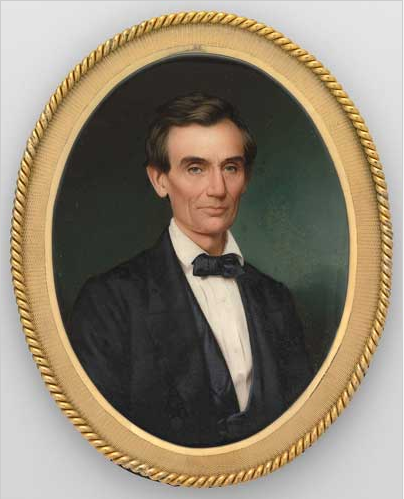 |
| John Henry Brown (1818–1891) Watercolor on ivory, 1860 National Portrait Gallery, Smithsonian Institution Conserved with funds from the Smithsonian Women’s Committee |
Stop by the Lincoln Heriatge Museum today to see other renderings of President Abraham Lincoln.
Bibliography
Fact of the day sources
- R. Gerald McMurtry, Beardless Portraits of Abraham Lincoln Painted from Life (Fort Wayne, IN: Allen County Historical Society, 1962), 26-35
- Harold Holzer, Gabor S. Boritt, and Mark E. Neely, Jr., The Lincoln Image: Abraham Lincoln and the Popular Print (New York: Charles Scribner's Sons, 1984), 58, 61
- Michael Burlingame, With Lincoln in the White House: Letters, Memoranda, and Other Writings of John G. Nicolay, 1860-1865 (Carbondale: Southern Illinois University Press, 2000), 4-5
- Justin G. Turner and Linda Levitt Turner, Mary Todd Lincoln: Her Life and Letters (New York: Alfred A. Knopf, 1972), 65
- abraham lincoln to john m. read, 27 August 1860, CW, 4:102.
Monday, August 22, 2011
This day in 1853....
The Illinois Register reports on the incorporation of the town of Lincoln, 30 miles northeast of Springfield on Chicago & Mississippi Railroad. "The town was named by the proprietors of whom our enterprising citizen, Virgil Hickox, is one, in honor of A. Lincoln, esq., the attorney of the Chicago and Mississippi Railroad Company."
Stop by the Lincoln Heritage Museum today to view the original town plat of the city of Lincoln, Il!
Thursday, August 18, 2011
A Fair Chance
This day in 1864, President Lincoln speaks to 164th Ohio Regiment. The 164th Ohio Regiment was composed of militia whose 100-day term of service has expired.

"SOLDIERS---You are about to return to your homes and your friends, after having, as I learn, performed in camp a comparatively short term of duty in this great contest. I am greatly obliged to you, and to all who have come forward at the call of their country. I wish it might be more generally and universally understood what the country is now engaged in. We have, as all will agree, a free Government, where every man has a right to be equal with every other man. In this great struggle, this form of Government and every form of human right is endangered if our enemies succeed. There is more involved in this contest than is realized by every one. There is involved in this struggle the question whether your children and my children shall enjoy the privileges we have enjoyed. I say this in order to impress upon you, if you are not already so impressed, that no small matter should divert us from our great purpose. There may be some irregularities in the practical application of our system. It is fair that each man shall pay taxes in exact proportion to the value of his property; but if we should wait before collecting a tax to adjust the taxes upon each man in exact proportion with every other man, we should never collect any tax at all. There may be mistakes made sometimes; things may be done wrong while the officers of the Government do all they can to prevent mistakes. But I beg of you, as citizens of this great Republic, not to let your minds be carried off from the great work we have before us. This struggle is too large for you to be diverted from it by any small matter. When you return to your homes rise up to the height of a generation of men worthy of a free Government, and we will carry out the great work we have commenced. I return to you my sincere thanks, soldiers, for the honor you have done me this afternoon.”
Bibliography
The speech was taken from:
Basler, Roy P., Marion Dolores Pratt, and Lloyd A. Dunlap, eds., The Collected Works of Abraham Lincoln, 9 vols. Springfield, IL: Abraham Lincoln Association; New Brunswick, NJ: Rutgers University Press, 1953.

Photographer: Mathew B. Brady
Date: January 8, 1864
Place: Washington, DC
"SOLDIERS---You are about to return to your homes and your friends, after having, as I learn, performed in camp a comparatively short term of duty in this great contest. I am greatly obliged to you, and to all who have come forward at the call of their country. I wish it might be more generally and universally understood what the country is now engaged in. We have, as all will agree, a free Government, where every man has a right to be equal with every other man. In this great struggle, this form of Government and every form of human right is endangered if our enemies succeed. There is more involved in this contest than is realized by every one. There is involved in this struggle the question whether your children and my children shall enjoy the privileges we have enjoyed. I say this in order to impress upon you, if you are not already so impressed, that no small matter should divert us from our great purpose. There may be some irregularities in the practical application of our system. It is fair that each man shall pay taxes in exact proportion to the value of his property; but if we should wait before collecting a tax to adjust the taxes upon each man in exact proportion with every other man, we should never collect any tax at all. There may be mistakes made sometimes; things may be done wrong while the officers of the Government do all they can to prevent mistakes. But I beg of you, as citizens of this great Republic, not to let your minds be carried off from the great work we have before us. This struggle is too large for you to be diverted from it by any small matter. When you return to your homes rise up to the height of a generation of men worthy of a free Government, and we will carry out the great work we have commenced. I return to you my sincere thanks, soldiers, for the honor you have done me this afternoon.”
Bibliography
The speech was taken from:
Basler, Roy P., Marion Dolores Pratt, and Lloyd A. Dunlap, eds., The Collected Works of Abraham Lincoln, 9 vols. Springfield, IL: Abraham Lincoln Association; New Brunswick, NJ: Rutgers University Press, 1953.
Saturday, August 13, 2011
Museum Day!
Commemorating the 150th Anniversary
of the American Civil War
How did Abraham Lincoln, with little military experience, masterfully coordinate a victory to save the Union?
Hear a special talk from award-winning artist Jim Weren as he provides an informative and profusely illustrated presentation on

“Lincoln: the Commander in Chief”
Saturday, September 24, 2011
at 1:00 pm
Lincoln Heritage Museum
at Lincoln College
Admission is free
For more information, contact Ron Keller at 217-732-3155 or rkeller@lincolncollege.edu
Lincoln Heritage Museum is participating in
Museum Day, sponsored annually by the
Smithsonian Institute to promote visitor attendance
to America’s greatest museums.
Subscribe to:
Posts (Atom)